Quad Day: how the short was made
A 43 second animated short about Quad Day at the University of Illinois, made in late August 2026. The story is invented; the history around it is not. This page traces the film back to where each piece came from: the historical record it draws on, the decisions that shaped the cut, and the repairs the generated footage needed before it could ship.
Most people who saw this film assumed it came out of one prompt. It did not, and this page is the evidence. The picture and the sound were generated, eight segments of about five seconds each, but what is in them, where it is, and in what order were decided by hand, checked against the archive, and repaired frame by frame when the model got them wrong. In the director's own words, drafted for the post that announced it: "It wasn't one prompt. The shots are storyboarded, the buildings are locked to reference frames I built from photographs of the actual Quad, the sound is cut by hand, and the history came out of the archives."t
Three threads run through it. Historical material is what the film borrows from the record of Quad Day and of the Main Quad itself. The director's cut is how the story and the edit changed over eight days. Repair and restoration is what the generated footage needed before it could be shown. A companion note covers the same film from the cost side: what a finished second of generated film costs.
How it was made, in one paragraph. A script and eight prompts were written first.a Each segment was rendered by MiniMax H3, an open text-to-video model that produces picture and sound in one pass, on a single desktop machine (an NVIDIA DGX Spark, 1344×768, 124 frames, 20 steps). The first and last frame of most segments were pinned by a still image, a plate, made beforehand with gpt-image-2 from real photographs of the Quad. Everything after the render, the grade, the cuts, the transitions, the sound, the titles, was done in post with ffmpeg and small scripts.b Most of the writing, rendering and checking was done together with AI coding agents (Claude Code, Codex, opencode and Kimi Code); the decisions on this page were the director's.
1 · Historical material
The written record
The 1971 half of the film is not invented. Before any prompt was written, the history was collected from the university library, the alumni association and a dozen years of reporting in The Daily Illini, and every period beat in the script was tied to one of those sources.c No archival photograph or footage appears in the film; the record was used as a list of what really happened, and the model was asked to draw it.
| in the film | what the record says | source |
|---|---|---|
| the jump to 1971 | First Quad Day on September 10, 1971; Dan Perrino wanted students and faculty to start talking to each other; about 7,000 came | 1, 2, 4 |
| folk trio, bow-tied dean, volleyball | a faculty and student volleyball game, a hot dog stand and a talent show on the first day; a "country fair atmosphere" | 1, 2 |
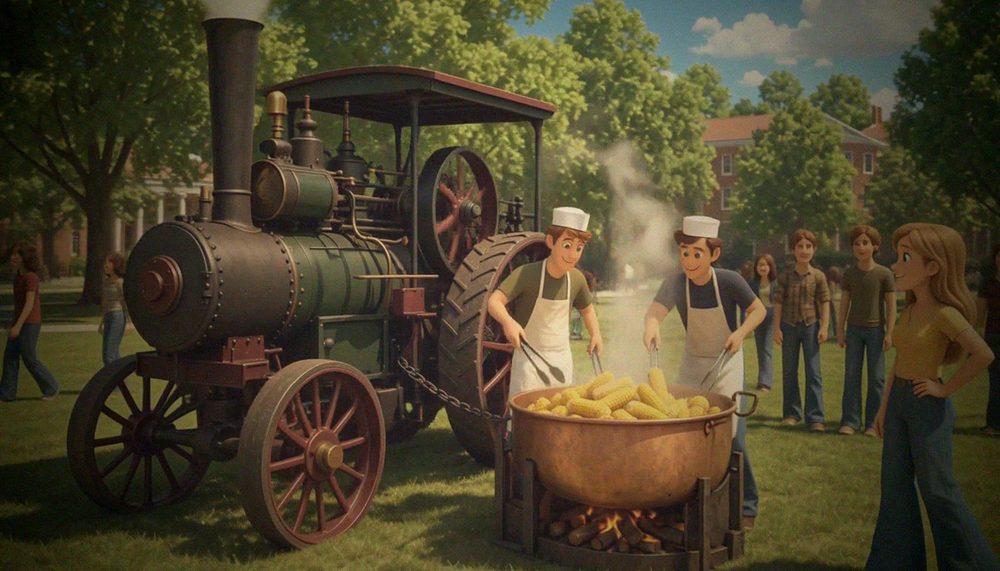
| segment 05, Corn on the Quad | ears boiled on a 1923 steam engine, more than 100,000 a year, ten to fifty cents each | 2 |
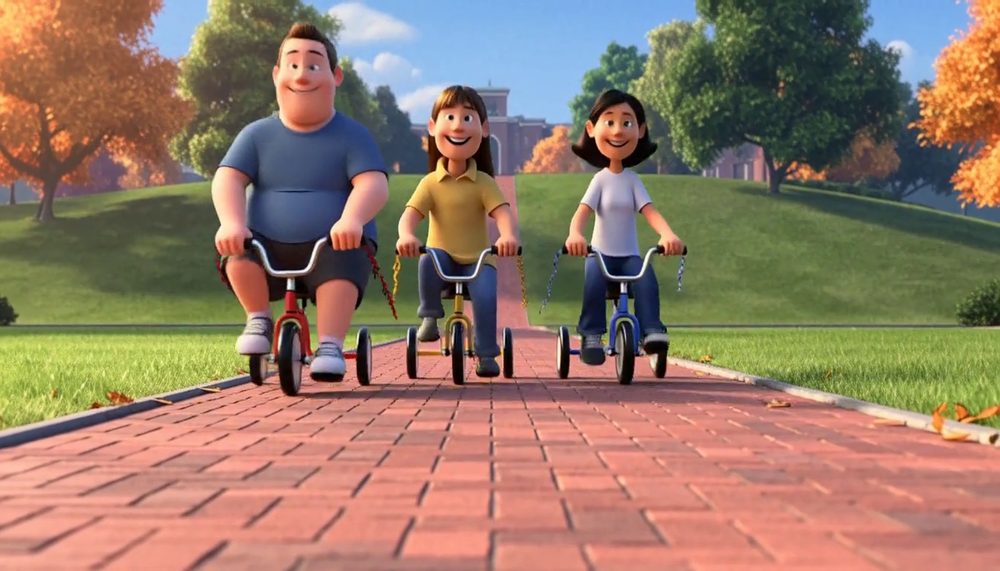
| segment 06, the 1980s montage | trike races, a slip 'n' slide, a dunk tank, a paper airplane contest; phased out when the day turned to student-organization recruiting in the 1990s | 2 |
| chimes in the cut opening (segment 01) | the first Quad Day opened with a 30 minute concert on the Altgeld Hall chimes; the event grew out of "Rap on Quad" | 3, 15 |
| service dogs, climbing wall | Illini Service Dogs' golden retrievers as the stars of the day; Campus Recreation's mobile climbing wall behind Foellinger | 9, 10 |
| the band on Foellinger's steps | the Marching Illini perform in front of Foellinger Auditorium on Quad Day | 9 |
| free t-shirts, flyers, sign-up sheets | free shirts are one of the main reasons people go; more than 1,000 registered organizations on the Sunday before classes | 5, 7, 8 |
What is invented: Nora, the squirrel, her one line ("I'll take one of everything"), and the time travel. The present-day activities are real but are a highlight reel drawn from write-ups of past years, not things seen on one particular Sunday.c One real detail was cut on purpose: the Illini Automotive Group really does bring a sports car onto the Quad,9 but the model parked it in the middle of a concrete walk where it read as a car driving through a crowd, so it came out.d
The place
The first complete pass of the film, on August 22, described the Main Quad in words and got a generic east coast campus back: a white New England spire, a small white rotunda, red brick walks, autumn colour. Part of that was the prompt's own fault. It said "red brick walkways" and "two long rows of tall elm trees", and both are wrong: the Quad's walks are pale concrete, and the elms along Burrill Avenue were replaced with honey locusts after Dutch elm disease in the late 1950s.13
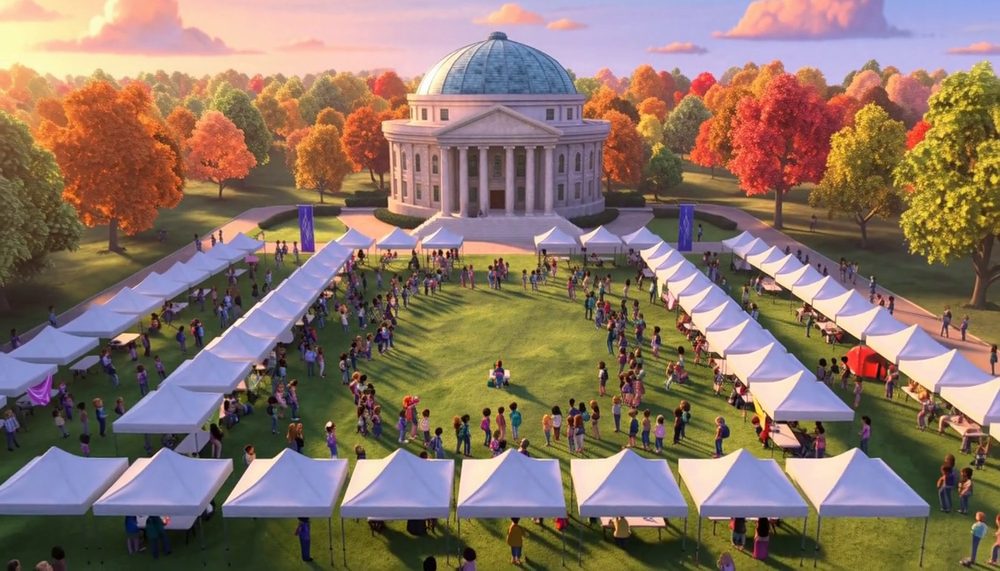
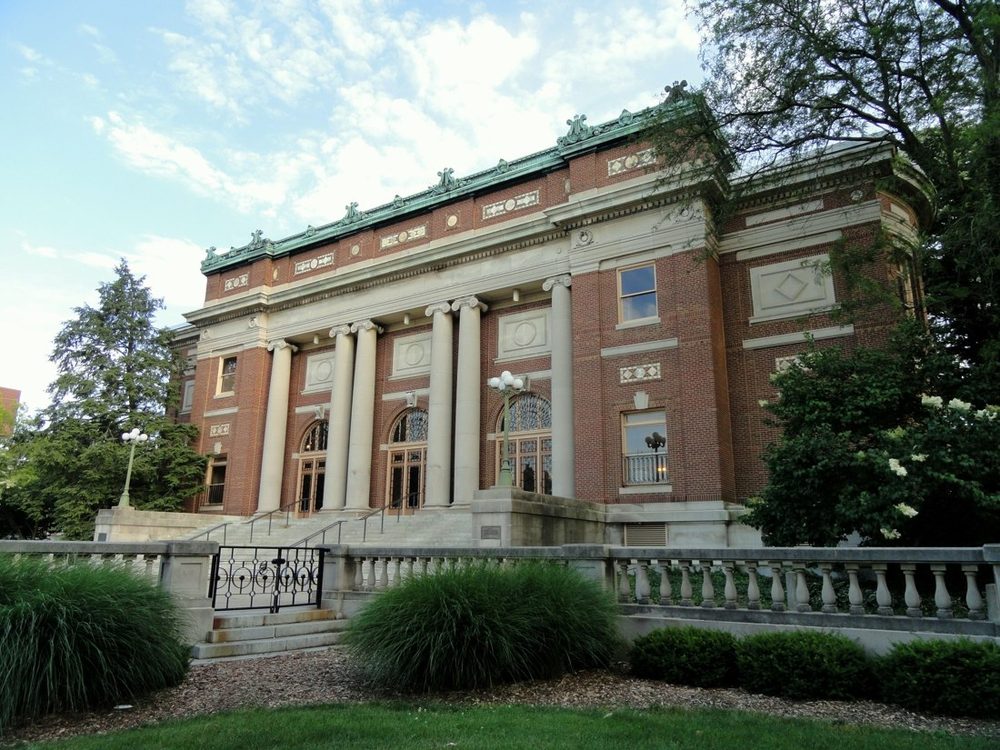
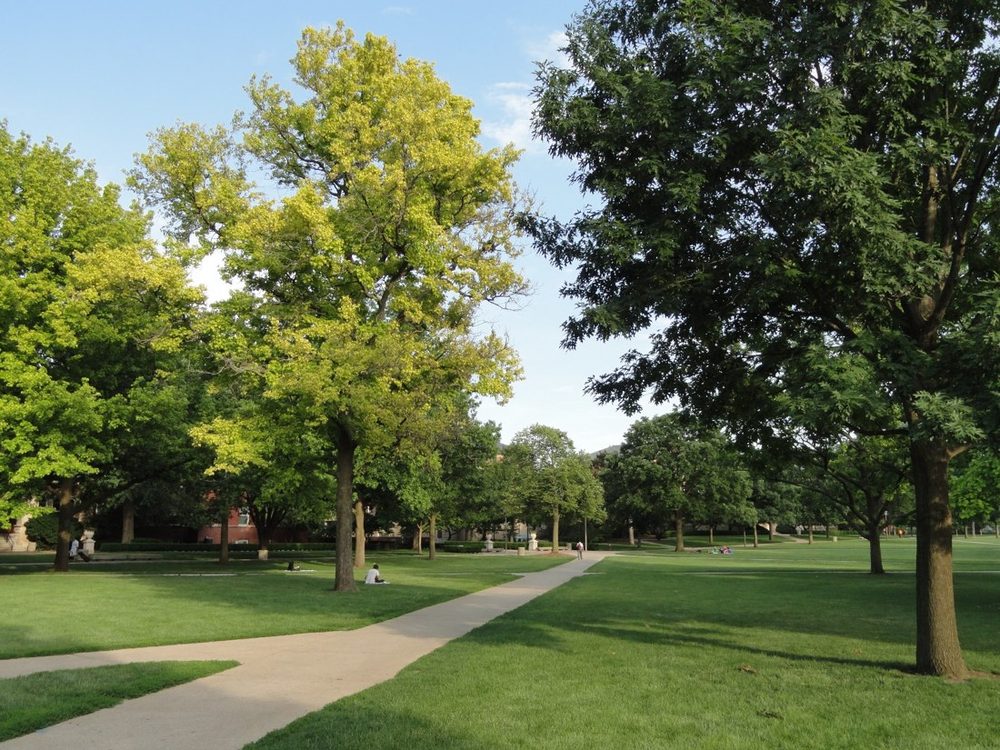
Correcting the words fixed only half of it, so the place was given to the model as a picture instead. A reference sheet listed every element of the real Quad against the wrong version: Foellinger's red brick rotunda at the south end, the Illini Union's white clock cupola at the north, the 203 by 940 foot lawn, concrete walks cut diagonally across it, the poster-covered concrete kiosks, black lamp posts, broad irregular oaks and honey locusts in late August green.e12, 14 Ten photographs from Wikimedia Commons were the geometry references for the first plates: four public-domain photographs by Daderot, one CC BY 2.0 panorama and five under CC BY-SA 4.0.e Their licences are listed under sources; only the public-domain ones are reproduced here.
The most useful references were not on Commons at all. On the evening of August 21, the director walked the Quad with a phone and photographed what no public archive had: Foellinger's columns wrapped for the start of semester in orange and navy, the Marching Illini rehearsing on the steps, the cheer squad's line on the grass, the low gold light.f Those photographs fixed the present-day segments, and later supplied the answer to a colleague's note that every band member looked like the same person (below). They show real students, so they are not reproduced here.
A small rule came out of the wrapped columns: they are a start-of-semester feature, so they appear only in the present-day segments and never in 1971 or the 1980s.g
The music archive
The plan for the score began in the archive too. The Illinois fight songs are old enough to be free. Illinois Loyalty, words and music by Thacher Howland Guild, was published in 1907, and a scan of the original U. of I. Supply Store edition was downloaded from the Internet Archive.16 Oskee Wow-Wow (1910, published 1911) was found in the Levy Sheet Music Collection at Johns Hopkins, and the University Archives and the Music and Performing Arts Library hold more.h Old recordings were ruled out: under the Music Modernization Act a 1931 recording stays protected until 2032.h
The closest call was the director's own recording. His phone video of the band rehearsing on August 21 was cleaned up and laid under the film as a score on August 23. An audio match against 109 reference recordings then identified the march: Edwin Franko Goldman's Illinois March (1953, dedicated to the university), matched in five independent windows.i A 1953 copyright had to be renewed in 1980 or 1981 to survive, and the Copyright Office's records show it was, on February 17, 1981 (RE0000084362).19 Within the hour the live score was taken off the film and a music-free master was cut.j
2 · The director's cut
Structure
The film is eight generated segments of 124 frames, 5.17 seconds each, cut together with a frozen tail for the title. The shape settled on the night of August 22 and did not change after that.a
| segment | what happens | time |
|---|---|---|
| 02 arrival | Nora walks onto the crowded Quad, stops, laughs, and runs in | present |
| 03a play | a flood of free stuff, three service dogs knock her over, the climbing wall | present |
| 03b theft | she takes one flyer; a fox squirrel snatches it and bolts; she gives chase | present |
| 04 1971 | the chase through a banner and a curtain of light into 1971 | history |
| 05 corn | Corn on the Quad and the 1923 steam engine | history |
| 06 gonzo | the band, the slip 'n' slide, the paper airplane, the dunk tank | history |
| 07 today | the airplane flies back to the present and lands in her hand; pan to the band on Foellinger's steps | present |
| 08 signup | she signs up; the squirrel returns the same flyer; crane up over the Quad | present |
Most of the editorial decisions were about taking things out. The ones that held:
- No establishing shot. Segment 01, a time-lapse of the empty Quad filling with tents, was rendered and then cut: the film already opens on a full Quad, and the time-lapse looked like a different film. The scale of the place now comes through her eyes, small in front of it in 02 and looking down from the climbing wall in 03a.a
- She does not speak until the end. An early line in 02, "Okay. Here we go.", made her sound like someone entering a dungeon. Quad Day is a fair, not a level. The only line left is at the end.a
- The present and the past each get 15.5 seconds. With one present-day segment the past was the fun part and the theft came out of nowhere, so segment 03 was split into play and theft.a
- The three beats of 03a are in order. Things are thrown at her, animals jump on her, she climbs on her own. Passive to active.a
- She runs into the frame, never out of it. Turning away would fight the direction of the chase that follows.g
- The brass at the end is in the picture. The band on Foellinger's steps is heard as part of the place, not as a score laid over it.g
- The early yellow trees in 07 stay. They had been logged as a bug since the first pass. On August 28 the director ruled that late August really has a few early yellow trees, and the note was closed.g
The other half of the method was choosing takes. Because every version was kept, the cut was often assembled from whichever render of a beat worked best, not from the newest: the older paper-airplane catch in 07 ("the old version is more natural"), the older sign-up shot in 08 with only the crane taken from a new render, and in the end an older 02.t
How the cut changed
| date | version | what changed |
|---|---|---|
| Aug 22, afternoon | first pass, 42.98 s | eight segments from text alone, all usable first time; generic campus, H3's own music in every segment |
| Aug 22, evening | plates | photographs of the real Quad locked in as first frames; squirrel recoloured to a real fox squirrel; trikes replaced by the band; 37.82 s cut |
| Aug 23, night | new structure, 42.98 s | 03 split into play and theft; 04 becomes a real chase; 02 loses its line; all eight segments re-rendered with the music turned off |
| Aug 23, day | no-music master | white flash at the time jump and a whip pan built in post; the live band score added and withdrawn (above); the sports car removed |
| Aug 23, night | co-ed band | colleagues' notes on the first Slack share: the band and cheer squad are co-ed, the band members should not share one face, and no car should look like it is chasing a pedestrian; 06 and 07 re-rendered |
| Aug 24 | sound passes, music | a minimal sound-effects pass approved; eight library tracks auditioned; "Under the Sun" chosen |
| Aug 24 – 27 | geometry fix | 02 and 03a rebuilt on the Quad's real layout over four attempts (below) |
| Aug 28, 01:29 | first public upload | the "Under the Sun" cut re-mixed on the new 02 and 03a, metadata stripped, put on Vimeo |
| Aug 28, morning | expression fix | five rewrites of one laugh, version D chosen; the whip pan replaced by a two-frame transition; 42.83 s |
| Aug 28, evening | final | sound surgery on four moments; the Vimeo upload replaced in place, the last time at 23:34, which is the release |
Every row is a commit in the production repositories, and every version before the last is still on disk, from the first-pass clips to the rejected variants.k
Directing a model whose seed is fixed
The seed was hard-coded to 42, so the same prompt always returned the same clip. A shot could not be nudged by rolling again; the only lever was the sentence. That made each review note a rewriting exercise, and the clearest example is a single laugh.
On August 28 the director flagged 03a: Nora laughs too hard, into the uncanny valley. Two causes were found frame by frame: the first-frame plate itself had that face, and the prompt said "laughing" with no limit. Five rewrites were rendered side by side, each pulling a different lever: cap the size of the laugh, swap it for other actions, move it into the eyes, hide its peak behind a prop, or pull the camera back.l
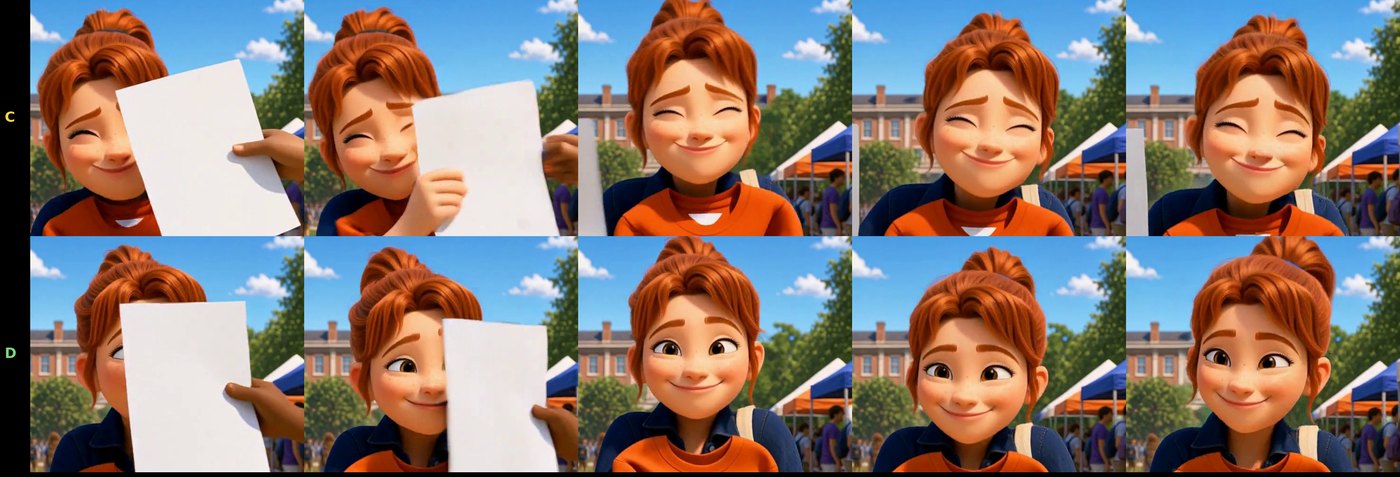
The rejected versions taught more than the winner. Replacing the laugh with other actions (B) came back looking like distress: closing the mouth without pinning the brow makes the model render suffering. A parallel attempt to merge 02 and 03a into one ten-second take, to remove the cut between them, found that a timecode at the start of a sentence is itself an instruction to cut; "WITHOUT ANY CUT" in capitals did not override it. The merge worked in a draft and was dropped in favour of a two-frame transition.l
Choosing the music
H3 generates music inside each segment, so eight segments meant eight unrelated scores in eight keys. Music was switched off for the whole film on August 22 and a single cue was to be laid over the locked picture.h After the live band recording was withdrawn, the archive route was tried once more and failed on the ear: the public-domain melodies rendered through a General MIDI soundfont were, in his words, "honestly awful"; a melody-conditioned music model produced something closer to a horror-film effect; an open-source song model was "terrible". Then eight tracks from free libraries were auditioned against the cut.t The director's notes, in order: "Under the Sun" was "the best of the set", "Games Worldbeat" and "Comical" were "fine", three others were rejected outright. "Under the Sun" runs at 117.5 beats per minute, almost exactly the picture's cutting grid at 116.12, which is part of why it sits so easily.m The director asked for it to play at full level under Nora's line rather than duck.
The release
The film went to Vimeo in the early hours of August 28 and to the campus subreddit the next day, with a one-line disclosure that the picture and sound were generated. Most replies read it as a one-shot. The post was taken down the same day, with a diagnosis written into the production notes: a one-line disclosure reads like no disclosure, and the evidence of the work has to be in the artifact, not next to it.n This page is that evidence.
3 · Repair and restoration
There is no restored archival photograph in this film: nothing old was colourised, upscaled or reanimated. What needed restoring was the generated footage itself. Every repair below was measured before and after, and the failed attempts are kept.
The geometry of the Quad
After the music was settled, a colleague caught what no review had: in 02 and 03a the tents formed a mirrored canyon along a central avenue, and "the UIUC quad doesn't have a walkway down the middle". The director added what he remembered from the day itself: booths stand on one side of a walk only, with open lawn on the other, and none stand on the paths. The real Main Quad's middle is lawn cut by diagonal paths.o, t
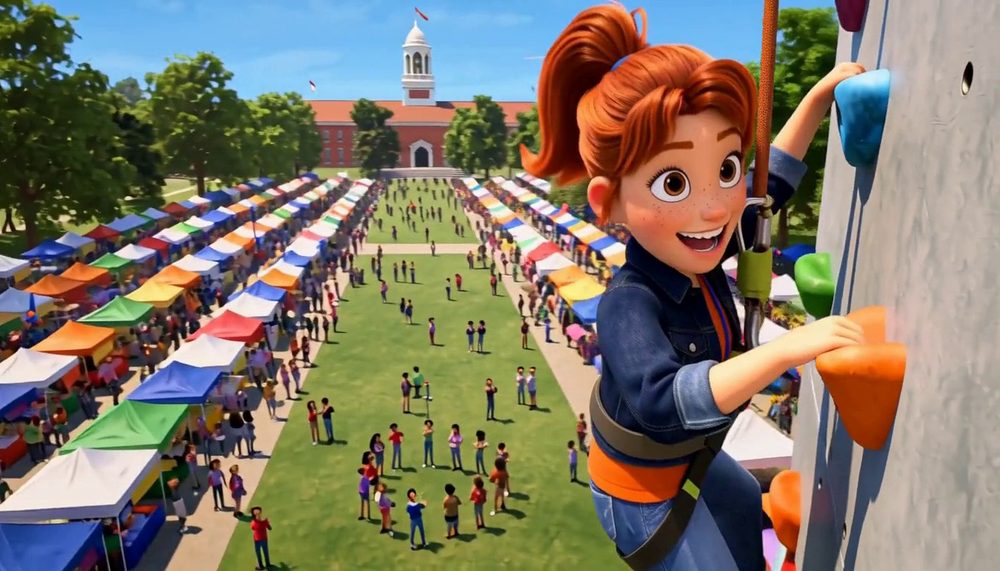
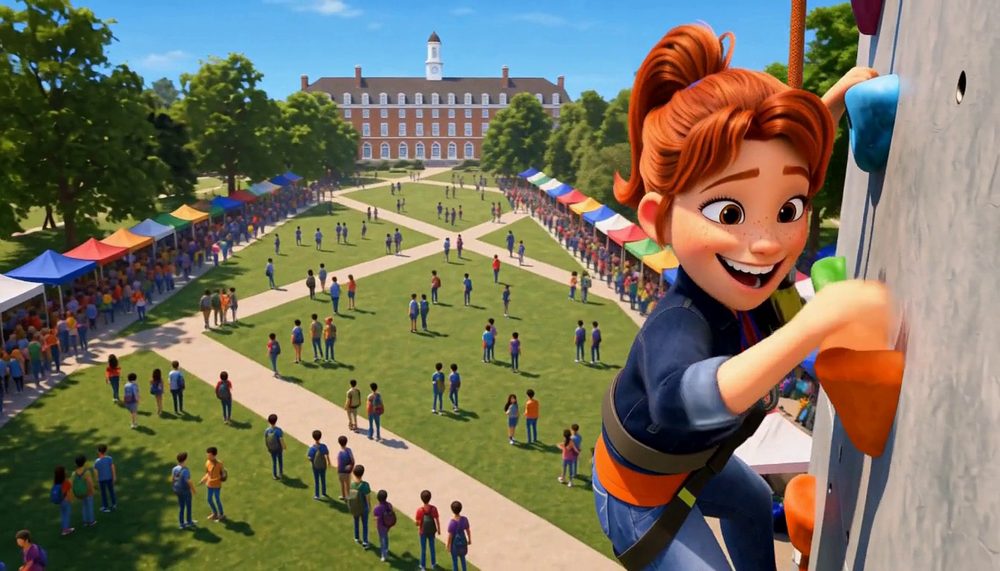
This was the hardest repair in the film, and it went through four attempts and three different coding agents over three days. The first, on August 24, re-rendered with a corrected background and broke everything else: Nora's fringe and ponytail changed, the pacing slowed, and a stale image cache in the render server kept serving old keyframes under new file names. It was archived and reverted. The second, with Codex on August 25, added the official 2026 Quad Day booth map as a reference and composited the old foreground over a lawn-only background; the director's verdict was that it was completely wrong, with booths now scattered over the lawn. The third, with opencode, put the approved Nora back pixel for pixel over the one background that had the geometry right.o
At that point the director asked for a clean copy of the last version that had nothing wrong with it but the buildings, the August 24 "Under the Sun" cut, and the work restarted there.p On August 26 the keyframes were rebuilt to a one-line spec of his: booths on the right, lawn and walkers on the left, a red brick building behind rather than the auditorium. Each later keyframe fixed one complaint: the crowd too thin, a floating hand, a flyer handed to a passer-by instead of to Nora. 03a passed that night. 02 did not: after a day of re-renders in which she ran on the spot or backwards, he called it ("02 can't be fixed, leave it") and the cut went back to an earlier take of 02 that already worked.p, t
The period look
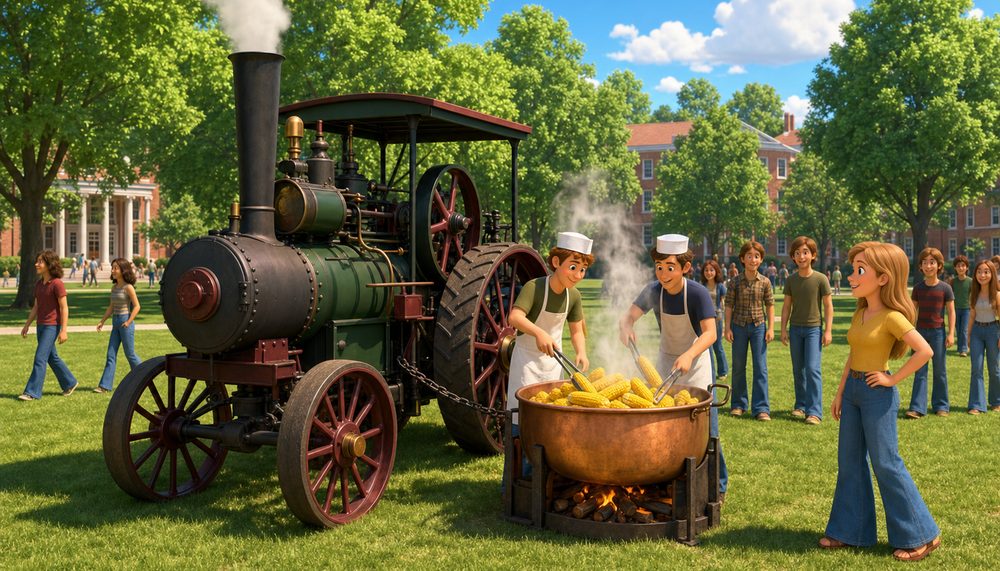
The prompts for 1971 asked for "warm grainy film stock, soft halation, faded colour, gate weave". The model drew the right period, the clothes, the folk trio, the hand-painted signs, and rendered it as clean modern CG. The look is a grade applied afterwards, which also let it switch on the exact frame where she crosses the light and fade out on the frame the airplane crosses back.b
The time jump
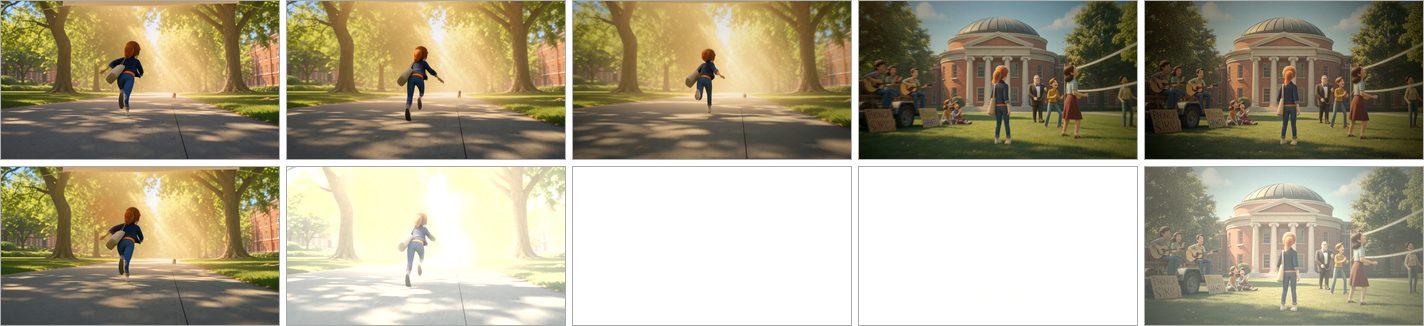
The director's note on 04 was that the jump into 1971 did not land. Measured frame by frame, the curtain of light in the render never went white: its brightest frame averaged 145 out of 255, with no pixel above 245, followed by a hard cut. She was never seen to pass through anything. A real white flash was built in post instead and lengthened twice at his request, ending at 20 frames up, 4 held, 28 down, with the cut hidden at its peak; the segment kept its 124 frames, so nothing else in the film moved.q
Continuity
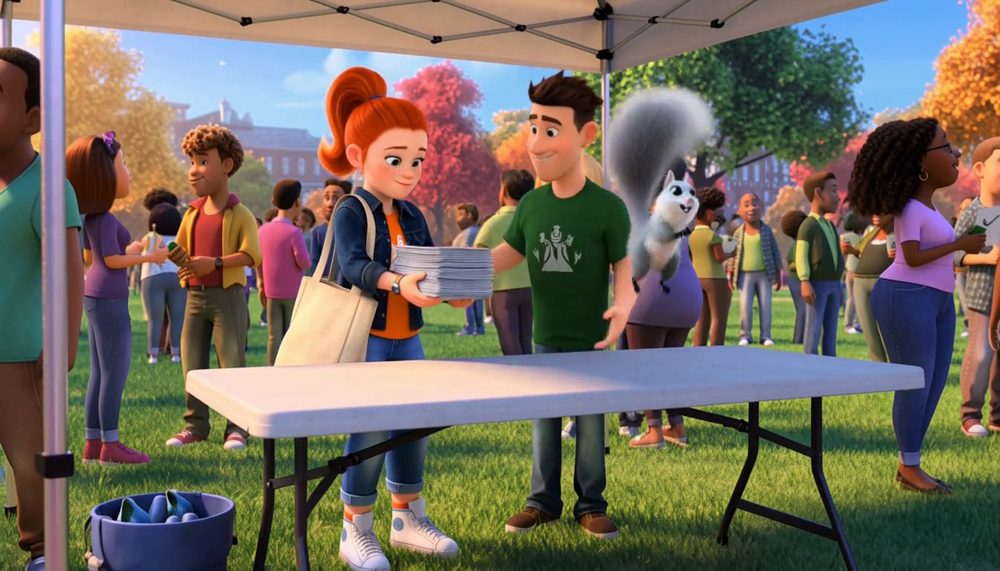
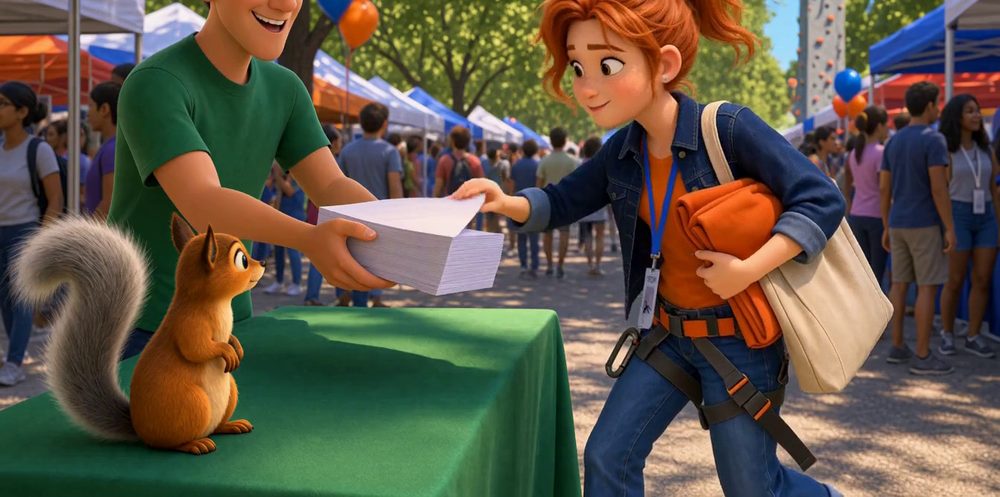
- Garbled lettering. The model writes on props, and small text comes out as nonsense: a flyer handed to Nora in 03a, a hand-painted sign in 1971. Telling it not to write did nothing. What worked was removing the prop or describing it as completely blank.g The end title was never left to the model; it is burned in with ffmpeg.
- The squirrel. The first draft asked for a "grey fox squirrel with a white belly", which merges two species. The Quad's fox squirrels are rust-orange with a frosted tail, and the prompt was rewritten to match.a
- A cut the model added itself. The first frame of 03a was, by accident, a copy of a plate with no Nora in it, while the prompt's first sentence asked to track backward in front of her. The model played half a second of empty aisle and then invented a cut. The rule: the first-frame plate must contain whatever the first sentence asks for.g
- The seam between 02 and 03a. A whip pan built from directional blur first covered the cut. Once 03a's first frame was set to 02's last frame, the seam needed only two blurred frames, 83 milliseconds.l
Sharpness and motion
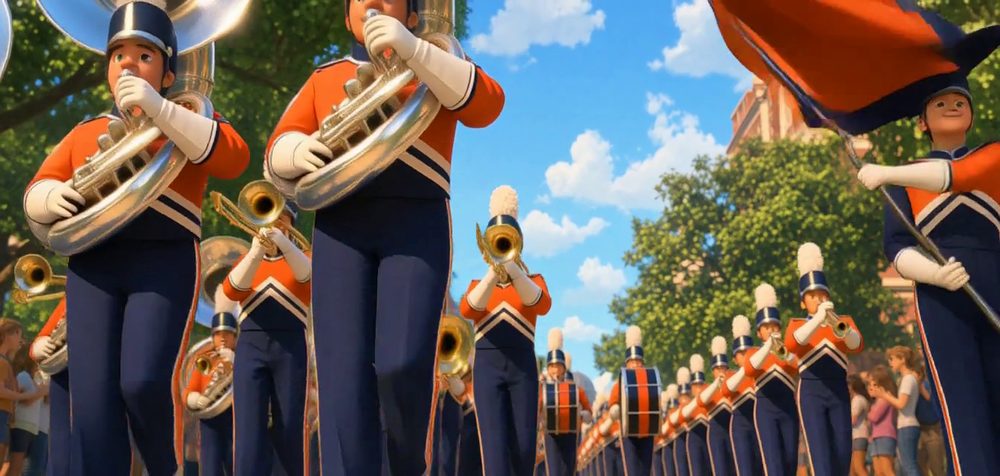
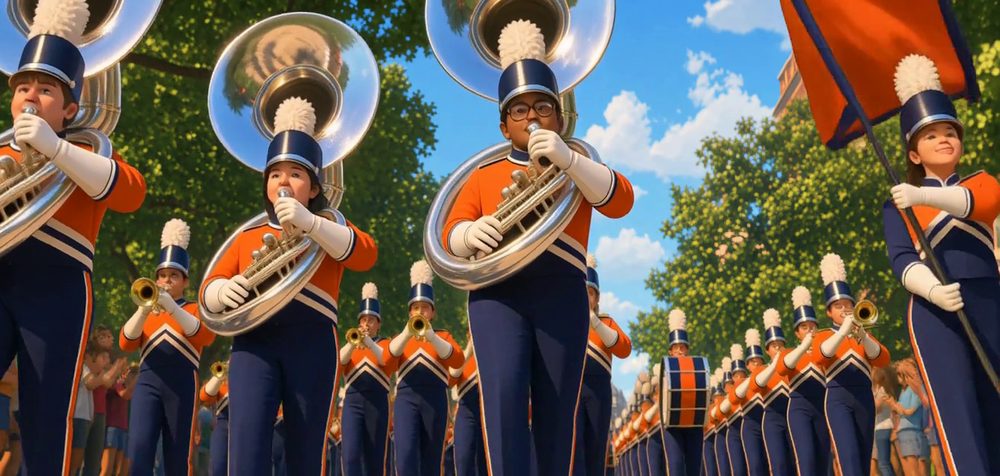
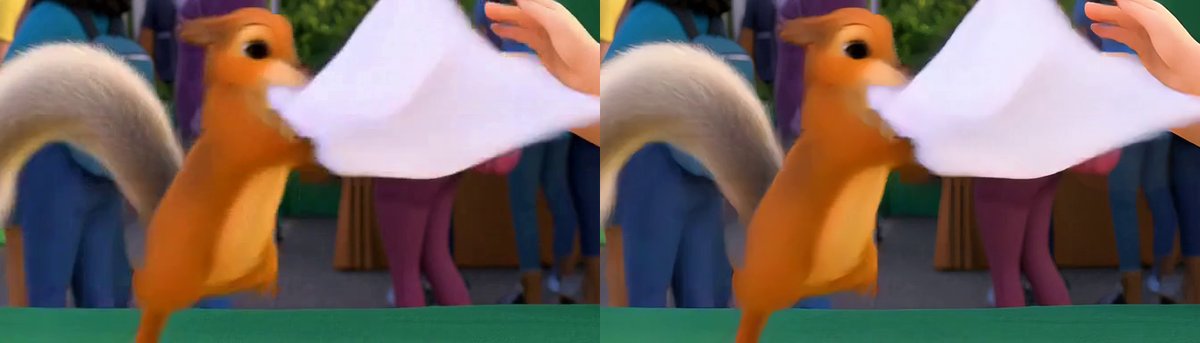
Three post-only repairs were tried and none of them shipped. Just after midnight on August 28, a 4× video super-resolution pass (RealViformer) over the whole finished film, scaled back to 1344 wide, sharpened fur and paper edges; the director's verdict was that it did not look good, and the release went out at native resolution (PSNR 33.7 dB, SSIM 0.914 against the original, for the record). Earlier that night, for the run in 02, which had rendered at an effective 12 frames per second with every other frame a near duplicate, the missing frames were synthesised from bidirectional optical flow, and a push-in in post tried to turn running on the spot into running toward the camera.r The 02 in the release is none of these: it is a fresh render from a new last-frame plate, a waist-up medium shot that gave the model less distance to cover, byte for byte the clip that was tested as qd_02_medium_plate.r
Sound
After listening to the upload on August 28 the director flagged three moments: the laugh at the end of 02 was abrupt, the dogs were fine, and a "success" sound on the climbing wall had to go because it fought the music. Measured, the problem with the laugh was its attack, not its loudness, and the climbing-wall sound was not a voice at all but a 50 Hz boom sitting on the music's bass line.l
| moment | measured | repair that shipped |
|---|---|---|
| laugh at the end of 02 | loudest peak in the film, −13.5 dB, rising 27 dB in 0.3 s | lowered 8 dB, to −21.6 dB, matching the dog moment the director had called fine (−21.8) |
| laugh as the shirt lands | a second hard onset | replaced with 0.55 s of nearby crowd ambience |
| climbing-wall "success" | 47–61 Hz boom, +26.8 dB below 120 Hz | cut out and patched with the ambience right after it; low band 26.7 → −1.0 dB |
| chime under the end crane | no clean ambience nearby to patch from | lowered 14 dB |
The surgery was done one layer down, on the mix before the music was added, so the patches never break a musical phrase. A frequency-split alternative removed 15.7 dB of the boom cleanly and is kept, but the director wanted it gone, not quieter.l
What the files carried
Before release the footage was audited for marks it might carry. There is no visible watermark (a statistical test across all clips would have caught a 2% overlay) and no audio watermark. The raw clips, though, carried the entire render workflow in their metadata, including every prompt and the seed, and the encoder had stamped its full settings into the stream. Both were stripped. One thing cannot be removed: the plates were made by an image model that marks its output, and since they condition the video, some of that mark is likely still in the frames. The title card says the film was animated with generative AI.s
Made at home. Not an official University of Illinois production, and not endorsed by it. The film shows university marks, and its music is licensed for the film only, so the film is all rights reserved and none of it is offered under an open licence. University marks are deliberately absent from the stills on this page.
Production notes, including the full provenance of every reference and the licence status of each, are kept on a private wiki page: Quad Day film (sign-in required).
Sources and credits
Public sources
- The First Quad Day, Student Life and Culture Archives, University of Illinois Library, 2015.
- Quad Day, University of Illinois Alumni Association, 2021.
- History of Quad Day: 40 years of campus tradition, The Daily Illini, 2013.
- First Quad Day fostered bond between students, faculty body, The Daily Illini, 2014.
- Quad Day, Student Engagement, University of Illinois.
- Quad Day, Fraternity & Sorority Affairs, University of Illinois.
- Quad Day makes its return, Chambana Today.
- Make your bucket list for Quad Day, The Daily Illini, 2019.
- On the scene at Quad Day 2022, The Daily Illini, 2022.
- Quad Day adds demonstration space for recruitment, The Daily Illini, 2012.
- RSOs to look out for at UIUC, The Daily Illini, 2024.
- University of Illinois Main Quadrangle, SAH Archipedia.
- Liberal Arts & Sciences and the Main Quad, The Design of the Built Environment, University of Illinois Library.
- Foellinger Auditorium, Wikipedia.
- Altgeld Chimes and Altgeld Hall, Wikipedia.
- T. H. Guild, Illinois Loyalty, U. of I. Supply Store, 1907. Internet Archive. Public domain in the US. Also on IMSLP (PMLP1168490).
- H. V. Hill and H. R. Green, Oskee Wow-Wow, 1911. Levy Sheet Music Collection, Johns Hopkins University. Public domain in the US.
- E. F. Goldman, Illinois March, arr. Erik Leidzén, 1953. Not public domain; see 19.
- US Copyright Office, Copyright Public Records System: renewal RE0000084362 (February 17, 1981) of EP0000074038 (August 25, 1953), "Illinois march. For full band."
- "Under the Sun", Michael Ramir C., Mixkit, Mixkit Stock Music Free License. In the film only.
Images on this page
- Foellinger Auditorium, Daderot, Wikimedia Commons. Public domain (released by the author). Resized.
- Main Quad, Daderot, Wikimedia Commons. Public domain (released by the author). Resized.
- All other images are frames and keyframe plates from the production, made by the author with MiniMax H3 and gpt-image-2, and are part of the film (all rights reserved). Frames were chosen and cropped so that no university mark is visible. The expression comparison is shared with the cost note.
Referenced but not reproduced
Used as geometry references for the keyframes, credited here and not shown: UIUC Main Quad Panorama by kosheahan (CC BY 2.0); photographs of Foellinger Auditorium and the Illini Union by Beyond My Ken, of the Main Quad and the Illini Union by Daniel Schwen, and of Quad Day by DustyCereal (all CC BY-SA 4.0); two further public-domain photographs by Daderot, one of Altgeld Hall and one of the Main Quad. Two references were added during the geometry repair: the official 2026 Quad Day map of the Main Quad from Student Engagement, and a photograph of the Illini Union from the Union's Instagram account. Their terms of reuse are not established, so they are described here and not shown. The director's own photographs and video of August 21, 2026 show identifiable students and are not reproduced.
Production record
Lettered notes point into the production repositories, which are not public. They are listed so each claim can be checked against a specific file or commit.
-
SCRIPT_zh.md, the script, segment table and the reason for each structural choice. -
README.md, render settings, first-pass wall clocks, the three post-production steps. -
SOURCES.md, the history sources and the list of what is real and what is invented. - Commits
12c15f1b,39e91750,e0721a46(August 23), the sports car removed from 03a. -
REFERENCE_UIUC.mdandref/urls.txt, the Quad element by element and each reference photograph with its licence. -
ref/live/, the director's photographs and frames from his video of August 21, 2026. -
HANDOFF.md, the settled decisions, open problems and lessons. -
music/MUSIC.mdandmusic/scores/, the score plan, the public-domain scores and why old recordings were excluded. -
music/IDENTIFY2.md, identification of the band recording against 109 references, and the renewal record. - Commits
bfdd677a(live score, 13:24),2c18de60(march identified, 14:38),0f253f32(renewal confirmed, 14:57) and4cb91f3c(no-music master, 15:56), all August 23. - Git history of
quad-day-film(58 commits, August 22–25) andquad-day-uts(73 commits, August 25–29). -
variants/README.md, the five expression rewrites, the ten-second merge and the sound repairs. -
music/candidates_web/README.md, the shortlist, licences and the director's audition notes. -
outreach/reddit_uiuc.mdand commit3ec4bd5(August 29). -
analysis/quad_geometry_fix/README.mdand commitsc012dd3e,5ba68bc5,8abd3f75(August 25). -
MIRROR.mdand commitsd90304fthrough4b0d5f1(August 26). -
analysis/portal/REPORT.mdand commit711a5ac2. - Commit
c212841(August 28), the scriptsdeflicker_run.pyandpost_zoom.py, test renders inwork/bgfix/diag/, comparison frames inwork/vsr/;clips/qd_02_arrival_00001_.mp4has the same MD5 aswork/bgfix/diag/qd_02_medium_plate.mp4. -
SANITIZE.mdandsanitize.sh. - The agent session logs of the production (Claude Code, Codex, opencode, Kimi Code), August 22–29, 2026. Quotations are translated from Chinese where needed; session identifiers are listed in the private notes.