About

I am a Research Assistant Professor in the Siebel School of Computing and Data Science at the University of Illinois Urbana-Champaign, and the PI of TechWave Lab. The name comes from what we hope to understand: how technology waves rise, spread, and fade. Studying this systematically used to feel out of reach. A single cycle leaves traces in papers, patents, investment, jobs, products, and firms, far more than a small team could ever pull together. AI agents have changed that. With them, we research technology cycles at scale, build the tools this work needs, and teach others to use them.

Alongside the lab's agenda, my own research lowers the cost and adoption barriers of large language models and LLM agents: measuring what deployment actually costs in compute, tokens and hardware, building tools that make models easier to run, as in the Local Host Lab notebook, and developing agent pipelines that make population-scale empirical studies feasible.

I received my Ph.D. in Computer Science from the University of Toronto, advised by Tovi Grossman. My doctoral work was on interaction techniques for extended reality and personal devices.

Interests

  • Large language models and AI agents
  • Economics of AI and technology adoption
  • Cost-efficient LLM inference
  • Extended reality

Education

  • Ph.D. in Computer Science, University of Toronto2018 to 2025
  • M.P.S., Interactive Telecommunications Program, New York University2015 to 2017
  • B.S. in Physics, Peking University2011 to 2015
Research agenda

AI agents as research instruments

My current work is done with TechWave Lab: measuring technology at scale, building tools, and teaching people to use and build AI agents. The lab's site has the projects, tools and courses in full.

Visit TechWave Lab

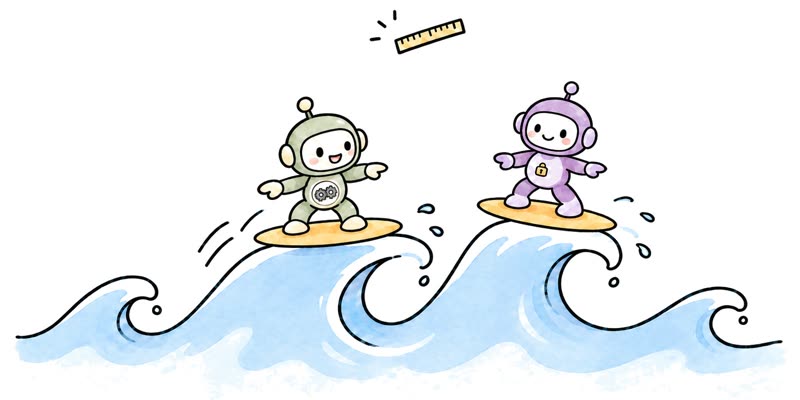
Illustration: an open-model robot surfing a wave just behind a closed-model robot, with a ruler measuring the gap

Research

Measuring technology at scale

How technologies rise, spread and pay off, and what they do to work and firms, measured with public records that AI agents let us assemble at scale.

  • Open Ruler Data note. When do open weights catch closed models? The gap between the best open-weight and closed models on a common capability scale, with prices, tracked daily since January 2025.
  • XR Life Cycle Data note. XR traced through innovation, investment, jobs and adoption. Public attention peaked in 2016, sales and investment in 2021.
  • Self-driving labs Work in progress. About 1,700 papers meet the field's strict definition; two in three of them never use the label.
  • All research
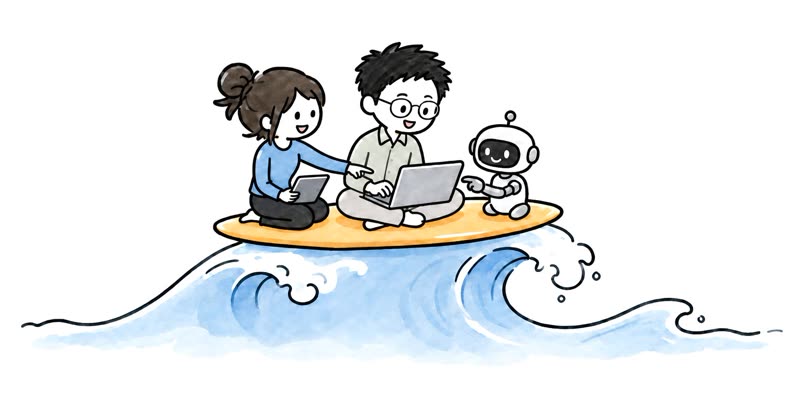
Illustration: two people and a small robot working on a laptop together on a surfboard

Build

Building tools

Tools our own research needs, built to keep costs down and released openly.

  • Agent Hub A free online AI agent workspace for students, researchers and the public, built to make using AI agents for research and teaching efficient and secure. Hosted online, for both the agent and locally hosted models. Guide on the wiki.
  • Local Host Lab How much of frontier AI a lab can run itself: 2026 open models on GPUs we can reach, from 2017 V100s to a DGX Spark, desktop cards and a Mac.
  • Techwave Wiki Open-source tools, setups that work, and field notes, with a built-in assistant that answers questions and cites the pages.
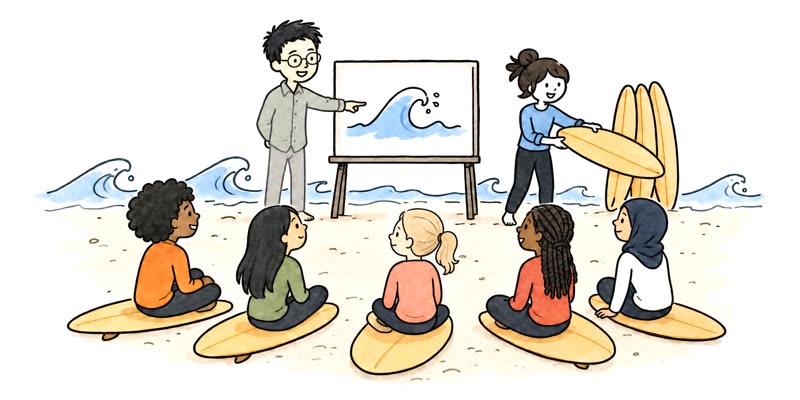
Illustration: a class sitting on surfboards on a beach while an instructor points to a wave drawn on a whiteboard

Teach

Teaching AI agents

Courses and hands-on workshops that take people from using AI agents to building their own.

A 44-second explainer for Open Ruler: When do open weights catch closed models?
Agent Hub: the chart, PDF and Markdown report an agent produced for one request open beside the conversation.

Earlier work

Extended reality

Illustration: a person wearing a headset surfing a wave

My Ph.D. research developed interaction techniques for extended reality and personal devices. I was also a Student Researcher at Google Labs and a research intern at NVIDIA Research.

Ph.D. projects and selected publications

Selected publications

  1. H. Wang, F. Zhu, B. Huang, Z. Wang, L. Sidenmark. Prop-Chromeleon: Adaptive Haptic Props in Mixed Reality through Generative Artificial Intelligence. ACM DIS 2026. Honorable Mention Award.
  2. F. Zhu, X. Qian, D. Kalmar, M. Tayarani, E. J. Gonzalez, M. Gonzalez-Franco, D. Kim, R. Du. Beyond the Phone: Exploring Phone-XR Integration through Multi-View Transitions for Real-World Applications. IEEE VR 2025.
  3. F. Zhu, M. Sousa, L. Sidenmark, T. Grossman. PhoneInVR: An Evaluation of Spatial Anchoring and Interaction Techniques for Smartphone Usage in Virtual Reality. ACM CHI 2024.
  4. F. Zhu, L. Sidenmark, M. Sousa, T. Grossman. PinchLens: Applying Spatial Magnification and Adaptive Control Display Gain for Precise Selection in Virtual Reality. IEEE ISMAR 2023.
  5. F. Zhu, Z. Lyu, M. Sousa, T. Grossman. Touching the Droid: Understanding and Improving Touch Precision with Mobile Devices in Virtual Reality. IEEE ISMAR 2022.
  6. F. Zhu, T. Grossman. BISHARE: Exploring Bidirectional Interactions Between Smartphones and Head-Mounted Augmented Reality. ACM CHI 2020.

Full list, patents and service in the CV.

See more earlier work

Contact

Email

zhufy@illinois.edu

Lab

TechWave Lab
University of Illinois Urbana-Champaign

Department

Siebel School of Computing and Data Science
The Grainger College of Engineering